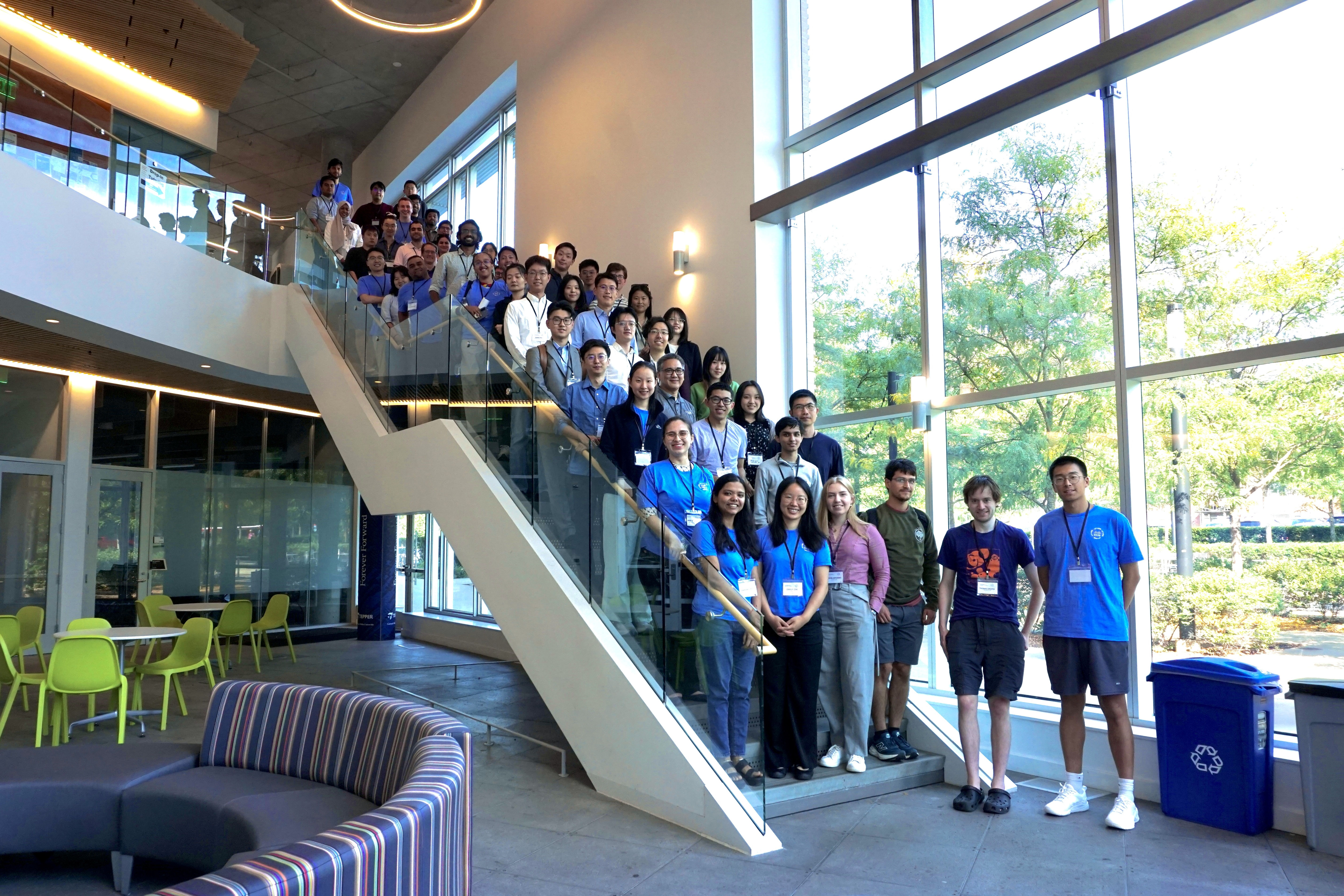
Welcome back from the ninth YinzOR Student Conference! On August 21–22, the CMU INFORMS Student Chapter welcomed nearly 100 students, researchers, faculty, and industry guests to the Tepper School of Business for two days of research, conversation, and community. Participants joined us from Pittsburgh and from universities across the country and beyond, bringing work from many corners of the broader Operations Research and Management Science community.
YinzOR has always been a student-organized conference, and we care about keeping it accessible to students. Registration remained completely free, while accepted student presenters received complimentary hotel accommodations and support with poster printing. None of this would have been possible without our sponsors, Hexaly and Highmark Health, whose support helped us keep the conference open and affordable while providing a full two-day program for our participants.
The conference began with a welcome from the organizing committee, followed by remarks from our faculty advisor, Professor Fatma Kılınç-Karzan, and Professor Duane Seppi from the Tepper Dean’s Office. Professor Kılınç-Karzan placed this year’s gathering in the longer history of YinzOR and the CMU INFORMS Student Chapter, reminding us that each conference builds on the work of the students who came before it. Professor Seppi welcomed our visitors to Tepper with wit, including a memorable reflection on what it means to be a Pittsburgh “Yinzer”—and, for the weekend, perhaps a “YinzOR.” The joke resurfaced more than once over the next two days.
Friday’s invited talks reflected the breadth of the INFORMS community. Vianney Coppé of Hexaly opened the research program with new approaches to difficult scheduling problems, followed by Professor Pengyu Qian of Boston University, who studied congestion and waiting lists in organ allocation. After our first coffee break, Professor Hannah Li of Columbia Business School spoke about machine-learning systems operating under real capacity constraints, while Professor Brian Jabarian of Carnegie Mellon University shared a field experiment on the use of voice AI in job interviews. The subjects ranged widely, which was part of the point: YinzOR gives people working on very different problems a chance to listen to one another, ask questions outside their usual subfields, and find points of connection.
Student research then took center stage in our 10-Minute Flash Talk Competition. Presenters had just ten minutes to make an audience care about a research question—no small task when that audience included people from many different parts of OR/MS. The competition rewarded not only strong research but the ability to communicate it clearly to a broad audience. This year, both the Flash Talk and Poster competitions offered prizes of $400, $300, and $200 for the top three presentations, together with a $100 Fan Favorite award selected by attendees. Congratulations to all of our presenters and awardees, and thank you to our faculty judges for giving each presentation their time and attention.
After a full afternoon, everyone moved upstairs for the Conference Dinner and Reception in the PNC Room. Some of the most useful parts of a conference happen after the formal program has ended for the day: conversations continue over dinner, people return to questions they did not have time to ask after a talk, and participants begin to recognize people they had not known a few hours earlier. We tried to encourage that from the moment people arrived, including by placing numbers on name cards as a small invitation to find and introduce yourself to someone new during the breaks.
Saturday began with breakfast and coffee before Professor Park Sinchaisri of UC Berkeley opened the morning program with work on the design of algorithmic advice. Professor Xiaomeng Chen of the University of Pittsburgh followed with research on how changes in online platforms can shape the communities that form around them.
After lunch, the PNC Room was transformed for the Interactive Poster Session, where student presenters stood beside their work while faculty judges and attendees moved through the room. The format made space for a different kind of conversation than a formal talk: questions could linger, presenters could adjust their explanations to different listeners, and discussions often continued well beyond the first few minutes.
The final research sessions brought us back together in Tepper 3801. Professor Reem Khir of Purdue University spoke about flexibility in facility logistics, and Matt J. Milligan of Highmark Health closed the invited program with a talk memorably titled Explaining GPS to Galileo: On building toward something we don’t quite yet see. Together, this year’s speakers represented universities and industry and a wide range of questions within and around OR/MS—a fitting picture of the larger community in which YinzOR sits.
Our final remarks came from Professor Alan Scheller-Wolf. Reflecting on the Age of AI, he turned our attention toward something technology cannot replace: our relationships with one another. As more tasks become automated and more information becomes immediately available, he argued, personal connection becomes more—not less—valuable. After two days spent presenting ideas, asking questions, sharing meals, and meeting new people, it was an apt note on which to close the formal program.
The conference then returned to the PNC Room for our Happy Hour and Social Event, where conversations from the previous two days continued over food and drinks.
A conference like YinzOR depends on a great deal of work that most participants never see. We owe a tremendous thank-you to our student volunteers, who gave their time throughout the weekend and stepped in wherever they were needed. We are equally grateful to the many Tepper staff members who made it possible for us to run the conference as planned: Lawrence Rapp and Laila Lee, Stephen Farrow and the Building Operations team, and Tepper staff who helped us navigate hotels, rooms, furniture, coffee breaks, AV systems, supplies, setup, cleanup, and a steady stream of last-minute changes.
YinzOR gives students a place to present research and meet people beyond their immediate departments and universities, but the exchange does not run in only one direction. This year’s program also brought junior faculty and industry speakers to Pittsburgh to share new work and take part in the same conversations. One of the things we value most is having researchers at different stages of their careers in the same room: students can encounter scholars whose careers are only a few steps ahead of their own, while speakers and faculty have a chance to meet the next generation of the broader INFORMS community.
Nine conferences in, we were glad to carry that tradition forward this year. Next year will mark the 10th YinzOR Student Conference, and we look forward to celebrating a decade of the conference—and to seeing where the students who organize it next will take it.
YinzOR 2026 Organizing Team: Emily Cai and Daniel Yamín (Co-Chairs), Stephen Arndt (Logistics Co-Chair), Lin An and Shuyi Chen (Speaker Co-Chairs), H. Satyam Verma and Xinxin Li (Website Co-Chairs), Aurora Yu (Marketing Co-Chair), and Wenbin Zhou and Anshika Shristi (Flash Talk & Poster Co-Chairs).
Learn more about YinzOR at yinzor.cmuinforms.org.
